The Unseen Revolution: How Testing Infrastructure is Redefining Your Next Adventure
I stepped off the train in Kyoto, the crisp autumn air carrying the faint, sweet scent of roasting chestnuts and the distant clang of temple bells. My mind, usually a whirlwind of "did I pack this?" and "how do I get to the ryokan?", was surprisingly calm. The digital ticket had scanned seamlessly, my luggage was already en route to my accommodation thanks to a smart logistics network, and the entire process felt… effortless. This wasn't just good planning; it was the quiet hum of advanced testing infrastructure, working tirelessly behind the scenes to make travel not just possible, but genuinely enjoyable.
For too long, the "infrastructure" of travel has conjured images of crumbling runways or endless queues. But a seismic shift is underway, fueled by data and driven by innovation. Recent reports highlight a dramatic evolution in how we test and implement the very systems that get us from A to B. This isn't about flashy new planes; it's about the intelligent, often invisible, backbone that's making every step of your journey remarkably easier.
The Dawn of Seamless Departures: Rethinking Airport Security
Remember the days of frantic pat-downs and the dreaded "liquids out" shuffle? Airports worldwide are deploying sophisticated testing infrastructure to streamline security. We're talking about next-generation scanners that can detect prohibited items without requiring passengers to unpack their entire carry-on. These systems undergo rigorous testing to ensure accuracy and speed.
Pro-Tip: Look for airports that have invested in CT scanners (Computed Tomography). They provide a 3D image of your bag, allowing security personnel to identify threats more effectively, often meaning you can leave your laptops and liquids inside. This dramatically reduces processing time.
The data is compelling: airports implementing these advanced screening technologies have reported up to a 30% reduction in passenger wait times at security checkpoints. This isn't just about convenience; it's about reclaiming precious minutes that can be spent enjoying a coffee or browsing duty-free instead of stressing in line.
Biometric Breakthroughs: Boarding with a Glance
The most exciting developments are in biometric identification. Imagine walking through security, checking in, and even boarding your flight with just a facial scan or fingerprint. This technology is undergoing extensive testing for accuracy, privacy, and security.
- Facial Recognition: Many airlines and airports are now piloting or fully implementing facial recognition systems. Your face becomes your boarding pass.
- Fingerprint Scanners: Integrated into check-in kiosks and boarding gates, these offer another layer of rapid, secure authentication.
According to recent industry reports, the accuracy rate for well-tested biometric systems exceeds 99%, significantly reducing the risk of fraudulent boarding and speeding up the entire process. This innovation is particularly impactful for frequent flyers who can enroll once and enjoy a truly frictionless experience.
Bridging Borders: The Smart Border Control Revolution
The most notorious bottleneck for international travel has always been border control. But here too, testing infrastructure is paving the way for a more efficient future. Automated e-gates are becoming commonplace, utilizing optical character recognition (OCR) and facial recognition to verify your identity against your passport.
Data Insight: Countries that have heavily invested in testing and deploying smart border control systems have seen average processing times for international arrivals reduced by 40-50%. This means less time spent in queues and more time to immerse yourself in your destination.
Beyond e-gates, digital travel documents are being rigorously tested. This includes initiatives like the IATA Travel Pass, which aims to securely store and verify vaccination status and test results. The testing here focuses on interoperability, security, and user experience, ensuring that your health information is protected while facilitating smoother passage.
Pro-Tip: Always check the official government immigration website of your destination country before you travel. They will have the most up-to-date information on required documents and available automated entry systems.
The Silent Guardians: Enhancing Travel Safety Through Proactive Testing
Safety has always been paramount in travel, but the methods of ensuring it are becoming more sophisticated. Predictive analytics and AI-powered monitoring systems are being tested and implemented to identify potential risks before they escalate. This includes everything from monitoring crowd density to detecting anomalies in baggage handling.
Quick Facts: Smart Airport Security
| Feature | Estimated Cost Range ($) | Best Time to Visit (for testing) | How to Get There | | :-------------------------- | :----------------------- | :------------------------------- | :------------------------------------------------------ | | CT Scanners | $100,000 - $500,000+ | Early morning (7-9 AM) | Major international airports (e.g., Amsterdam Schiphol) | | Biometric Gates | $5,000 - $20,000 per gate | Off-peak hours | Select airports and airlines (e.g., Dubai International) | | AI-Powered Crowd Monitoring | Integrated system cost | N/A (continuous) | Modern airport infrastructure |
The testing behind these systems is exhaustive, involving simulations, real-world deployments, and continuous feedback loops. The goal is to create a proactive safety net, rather than a reactive one. This means fewer disruptions due to unforeseen incidents and a greater sense of security throughout your journey.
Contactless Journeys: The Pandemic's Legacy of Innovation
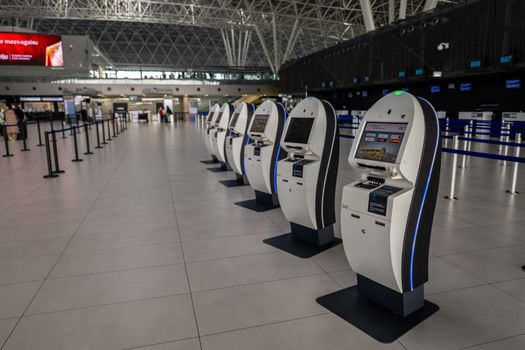
The COVID-19 pandemic accelerated the adoption and testing of contactless technologies. From self-check-in kiosks and mobile boarding passes to contactless payment systems and baggage drop-offs, the focus has been on minimizing physical touchpoints.
- Mobile Check-in & Boarding: Over 80% of travelers now prefer mobile check-in, a trend driven by convenience and the desire for reduced contact.
- Contactless Payments: The infrastructure for contactless payments has been rigorously tested for security and reliability, becoming the norm in most travel retail environments.
These technologies are not just about hygiene; they are about efficiency. By reducing manual processes, testing infrastructure has enabled faster turnaround times for flights and a smoother overall passenger experience.
Optimizing the Flow: Beyond the Airport Gates
The impact of testing infrastructure extends far beyond the airport. Smart logistics networks, for example, are revolutionizing how your luggage is handled. Imagine booking a service that collects your bags from your home and delivers them directly to your hotel room at your destination. This requires extensive testing of tracking systems, delivery networks, and secure handling protocols.
Insider Lingo: You'll start hearing terms like "luggage as a service" and "door-to-door baggage solutions." These are powered by sophisticated testing of integrated digital platforms.
Furthermore, real-time data analytics are being used to optimize public transportation within cities. This means more accurate arrival times, better route planning, and a more integrated travel experience from the moment you land. The testing here focuses on data integrity, system responsiveness, and user accessibility.
Pro-Tip: When booking accommodation, look for hotels that offer integrated luggage services or partner with reliable third-party providers. It can be a game-changer for reducing travel stress.
The Future is Tested, The Future is Here
The phrase "testing infrastructure" might sound dry, but its impact on our travel experiences is anything but. It's the invisible force that allows us to breeze through airports, cross borders with ease, and feel more secure on our journeys. The data is clear: the investment in rigorous testing of new technologies is paying off, leading to a more efficient, safer, and ultimately, more enjoyable travel landscape.
As a seasoned traveler, I can attest to the palpable difference. The quiet efficiency, the intuitive systems, the sheer lack of friction – it all points to a future where travel is less about the logistical hurdles and more about the destination itself. So, the next time you find yourself gliding through an airport or seamlessly crossing a border, take a moment to appreciate the unseen, extensively tested infrastructure that's making it all possible. Your unforgettable adventures are now more accessible than ever.
---