Remember that gut-wrenching feeling? You’re at the gate, boarding pass in hand, ready for your dream trip to Santorini. Then, the gate agent, with a smile that barely hides a glint of triumph, points to your perfectly normal-sized carry-on. "That'll be $60, please. It's oversized." My heart sank faster than a lead balloon. Sixty dollars! For a bag I’d flown countless times without issue. My carefully budgeted Greek island escape just got a little less dreamy.
That moment, standing there at Athens International, fumbling for my credit card, was my turning point. I vowed then and there: never again. I was done playing the airline’s game. I was going to crack the code, unravel the mystery, and unlock the secret to traveling the world without ever, ever paying a baggage fee again. And guess what? I did it. And today, I’m blowing the lid off my tried-and-true, mind-blowing strategies so you can too.
Welcome, fellow adventurers, to the revolution. This isn't just about saving money; it's about reclaiming your travel freedom, reducing stress, and experiencing the world with unparalleled ease. Get ready, because your travel life is about to change forever.
The Great Awakening: Why We Pay & Why We Shouldn't
Before we dive into the "how," let's understand the "why." Baggage fees, especially from budget carriers like Ryanair, Spirit, or Allegiant, aren't just an annoyance; they're a core part of their business model. They entice you with rock-bottom base fares, then recoup costs through "ancillary fees" – seat selection, priority boarding, and, yes, baggage. Even full-service airlines are increasingly strict, especially with international routes or basic economy fares.
For years, I was a chronic overpacker. "Just in case" was my mantra, resulting in a checked bag for a weekend trip to Tulum or a week-long adventure through Thailand. The fees added up, the waiting at baggage claim was tedious, and the constant fear of lost luggage was a dark cloud. But once I embraced the "carry-on only" philosophy, it wasn't just my wallet that thanked me; my entire travel experience transformed. I moved faster, felt lighter, and focused more on the destination than my belongings. This isn't just a hack; it's a lifestyle upgrade.
Section 1: The Carry-On Conundrum — Choosing Your Ultimate Weapon
Your bag is your battlefield. Choosing the right one is paramount. Forget the monstrous suitcases; we're talking sleek, efficient, and airline-compliant.
1. Know Your Dimensions (and Your Airline's): This is non-negotiable. Most major airlines (Delta, United, American, British Airways) allow carry-on bags around 22 x 14 x 9 inches (56 x 36 x 23 cm), including wheels and handles. Budget airlines can be stricter. Always check your specific airline before you even start packing. I keep a laminated card with common airline dimensions in my travel wallet.
2. Soft-Sided is Your Best Friend: While hardshell cases offer protection, soft-sided backpacks or duffels are more forgiving. They can be squished, molded, and tucked into tight overhead bins or under seats. My go-to for years has been the Osprey Farpoint 40L (or Fairview for women). It's a backpack that opens like a suitcase, has a proper harness system, and – crucially – fits perfectly within most carry-on limits. Another excellent option is the Nomatic Travel Bag 40L for its organization, or a simple, sturdy duffel from brands like Patagonia or The North Face. For a more stylish option, the Monos Carry-On Plus is a dream, but ensure it meets your specific airline's size for international trips.
3. The "Personal Item" Power-Up: This is where the magic truly happens. Every airline allows a "personal item" in addition to your carry-on. This usually means a laptop bag, purse, or small backpack that fits under the seat in front of you. This space is gold. We'll delve deeper into maximizing it, but for now, know that this bag is almost as important as your main carry-on. My current personal item is a sleek, expandable backpack from Aer Travel Pack 3 Small which surprisingly holds a lot without looking bulky.
Section 2: The Art of Illusion — Packing Like a Pro
Now that you have your perfect bags, let's fill them strategically. This isn't just about fitting everything; it's about making it look like it fits effortlessly.
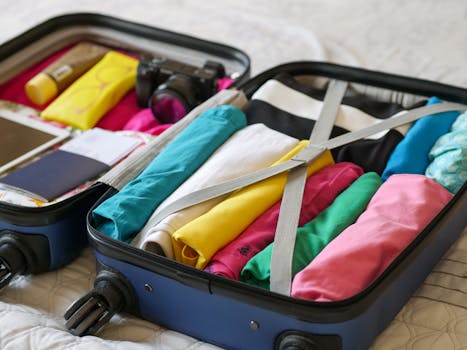
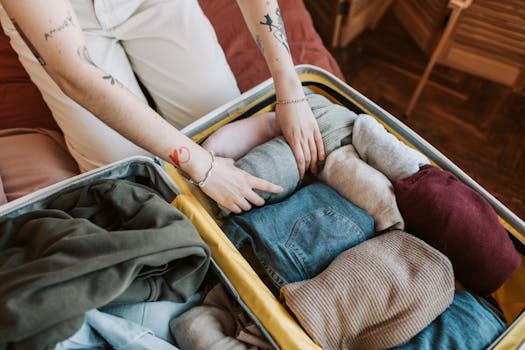
1. The Rolling vs. Folding Debate (Solved!): For years, I was a folder. Then, I became a roller. Now, I'm a packing cube enthusiast. Cubes aren't just for organization; they compress. Roll your clothes tightly into the packing cubes. This method allows you to compartmentalize, compress, and easily transfer items. I swear by Eagle Creek Pack-It Cubes – they’re durable and come in various sizes. For a two-week trip to Vietnam, I managed three outfits in one medium cube, two in a small, and my underwear/socks in an extra-small.
2. Capsule Wardrobe: Mix, Match, & Minimize: This is huge. Plan outfits, don't just pack clothes. Stick to a neutral color palette (blacks, grays, whites, navy) and add pops of color with accessories. Every top should go with every bottom. My rule: if an item doesn't work with at least three other pieces, it stays home. For my recent trip to Portugal, I packed 3 bottoms (jeans, black trousers, flowy skirt), 5 tops (2 t-shirts, 2 blouses, 1 light sweater), and a versatile jacket. Total outfits: endless!
3. The "Wear It On" Strategy: Your bulkiest items belong on your body, not in your bag. Wear your heaviest shoes (boots, chunky sneakers) on the plane. Layer your heaviest jacket or sweater. If you’re flying to Iceland in winter, wear that heavy parka, even if it feels a bit silly walking through a warm airport. It saves precious space and weight in your bag.
4. Toiletries: Miniaturize or Solidify: Full-sized bottles are the enemy. Invest in TSA-approved reusable travel containers (under 3.4oz/100ml). Better yet, embrace solid toiletries: shampoo bars, conditioner bars, solid sunscreen, and even solid lotion. They last longer, don’t leak, and don’t count towards your liquid allowance. My favorite shampoo bar from Lush Cosmetics has traveled with me across continents and saved me countless plastic bottles and space.
Section 3: The Personal Item Power Play – Your Under-Seat Secret Weapon
This is arguably the most underrated space in your travel arsenal. Most travelers underutilize their personal item, but savvy travelers know it's a second carry-on in disguise.
1. Strategic Stuffing (Discreetly): Your personal item should hold your essentials, yes, but also items that might push your main carry-on slightly over the edge. Think: your laptop, tablet, camera, a book, all your chargers, a full change of clothes (just in case!), and any heavier items like a water bottle. My current trick is to pack a lightweight, foldable tote bag inside my personal item. If my main carry-on feels just a bit too full, I can discreetly transfer a sweater or a book into the tote and carry it separately until I'm past the gate agent, then combine them again. (Use this sparingly and subtly!)
2. The "Pocket" Advantage: Many personal item backpacks or large totes have external pockets. These are perfect for items you need quick access to, but also for slightly bulkier items that you can stuff in without making the main compartment look overstuffed. Think snacks, a small umbrella, or even a pair of lightweight flip-flops.
3. The "Jacket Trick" for Extra Pockets: If you're wearing a multi-pocket travel jacket (like a Scottevest), you've essentially got extra personal item space on your person. Load up those pockets with your phone, passport, wallet, glasses, and even a small tablet. This lightens both your carry-on and personal item, making them appear less bulky to watchful eyes. I once saw a seasoned traveler at Heathrow with a fishing vest full of gadgets – extreme, but effective!
Section 4: The Travel Hacker's Arsenal — Tools & Tricks for the Savvy Nomad
Beyond packing techniques, there are specific tools and sneaky tricks that will ensure you never pay those fees again.
1. The Portable Luggage Scale: This is a game-changer. For under $20, you can buy a small, handheld digital luggage scale. Use it before you leave home. Weigh both your carry-on and personal item. This eliminates any guesswork and ensures you're within weight limits (if applicable – many airlines focus more on size for carry-ons, but some budget carriers do weigh). I check mine religiously before flying out of Kuala Lumpur, where AirAsia is notoriously strict.
2. Compression Sacks (Use with Caution!): These are fantastic for reducing volume, especially for bulky items like sweaters or jackets. However, remember they do not reduce weight. If your airline has a weight limit for carry-ons, a compressed bag might still be too heavy. They are ideal for maximizing space in a soft-sided bag when weight isn't the primary concern. I use them for dirty laundry to keep it separate and compact.
3. The "Gift Bag" Gambit (The Whispered Secret): This is a cheeky one, and I offer it with a wink and a caveat: use at your own risk, and only if absolutely desperate. If you find yourself needing to shed a few items from an overstuffed bag after check-in but before the gate, a common (though ethically debatable) trick is to buy something small at a duty-free shop and ask for a large gift bag. Discreetly transfer some items into this "shopping" bag. Gate agents are often less likely to question a branded shopping bag than a second personal bag. I've never personally used this, but I've seen it done in desperate situations on budget flights from Barcelona.
4. Laundry on the Go: The Ultimate Space Saver: One of the biggest reasons people overpack is the fear of running out of clean clothes. Conquer this by embracing travel laundry. Pack a universal sink stopper, a small tube of travel detergent (or a few detergent sheets), and a travel clothesline. Most hotels have soap, and you can wash essentials in your sink overnight. For longer trips, budget a stop at a local laundromat. This drastically cuts down on the number of outfits you need to pack. I survived a month in South America with just a week's worth of clothes thanks to strategic sink washing!
Section 5: The Airline Advantage — Loyalty, Credit Cards, & Savvy Booking
Sometimes, you don't even need to hack your packing; you just need to hack the system.
1. Airline-Branded Credit Cards: This is perhaps the most straightforward way to bypass baggage fees if you must check a bag. Many airline co-branded credit cards (e.g., Chase Sapphire Preferred, United Explorer Card, Delta SkyMiles American Express) offer a free first checked bag for the cardholder and often several companions on the same reservation. The annual fee for these cards often pays for itself after just one round trip with a checked bag. For example, my United Explorer Card saves me $35 per checked bag, per flight, for myself and a travel companion. That's $140 saved on a round-trip for two!
2. Elite Status Perks: If you fly frequently with one airline alliance (Star Alliance, SkyTeam, Oneworld), strive for elite status. Even low-tier status (like Star Alliance Silver or SkyTeam Elite) often includes a free checked bag, priority boarding, and other perks that enhance your travel experience. This requires loyalty, but the benefits are significant.
3. Book Smart, Not Just Cheap: Sometimes, a slightly more expensive fare on a full-service airline that includes a carry-on and personal item (or even a checked bag) can be cheaper than a "basic economy" fare on a budget airline once all the add-ons are factored in. Always calculate the total cost of your flight, including potential baggage fees, before clicking "book." I learned this the hard way flying from Rome to Mykonos – the "cheap" flight ended up costing more than a full-service option once I added my "oversized" carry-on.
4. Know Your Airline's Policy Inside Out: Don't just assume. Before every trip, pull up the specific baggage policy for your airline and your fare class. Some budget airlines, like Spirit, charge for all carry-ons that go in the overhead bin, only allowing a small personal item for free. Others, like Southwest, are famously generous with two free checked bags. Knowledge is power (and money saved!).
Section 6: The Mind-Blowing Revelation — It's More Than Just Money
While saving those $30, $60, or even $100 baggage fees is incredibly satisfying, the true "mind-blowing" aspect of this approach goes far beyond your wallet.
1. Freedom from Baggage Claim: Imagine landing after a long flight, bypassing the chaotic carousel, and walking straight out of the airport. No more anxious waiting, no more jostling for position, no more fear of your bag not showing up. It's pure bliss. I love being the first one out of the airport and into a taxi, leaving everyone else circling the carousel like vultures.
2. The Speed and Agility of Light Travel: Navigating public transport, climbing stairs in ancient European cities, hopping on and off trains in Japan – it's all infinitely easier with just a carry-on and a personal item. You're more agile, less burdened, and can spontaneously change plans without dragging a behemoth behind you. Picture yourself effortlessly sprinting through a connecting airport terminal, knowing your bags are always with you.
3. Never Lose Your Luggage Again: This is the holy grail. Your bag is always with you, under your watchful eye. The stress of lost luggage, delayed luggage, or damaged luggage becomes a relic of the past. For someone who travels constantly, this peace of mind is priceless.
4. Embrace the Minimalist Mindset: This approach forces you to be intentional about what you bring. You learn to appreciate experiences over possessions. You realize how little you truly need to explore the world. It’s a liberating feeling that extends beyond travel and into your daily life. My first carry-on-only trip to Iceland taught me that I really only needed half of what I thought I did.
Your Journey to Fee-Free Travel Starts Now!
The days of dreading the check-in counter or the gate agent's measuring tape are over. You now possess the knowledge, the tools, and the mindset to travel smarter, lighter, and absolutely fee-free. This isn't just about saving a few bucks; it's about unlocking a new level of travel freedom and enjoyment.
So, what are you waiting for? Start by assessing your current luggage, researching your next airline's policy, and planning your next capsule wardrobe. Your mind will be blown by how much easier and more enjoyable travel becomes.
Now it's your turn! What's your best baggage fee-busting hack? Share your tips and success stories in the comments below! Let's build a community of fee-free travelers!
---