The Epiphany on the Platform: Why June 2026 Belongs to the East
I stepped off the overnight sleeper train from Vienna into Budapest’s Keleti station, and my senses were instantly jolted awake. It wasn't the usual transit grime that caught me, but the sweet, caramelized scent of toasted cinnamon and yeast wafting from a nearby kürtőskalács stand, mingling with the crisp, cool air of a Hungarian June morning.
But the real showstopper was above me: a soaring, 19th-century iron-and-glass vault designed by János Feketeházy that felt less like a railway terminal and more like a cathedral dedicated to the age of steam. As the early morning sun filtered through the glass, casting long, geometric shadows across the platforms, it hit me: Western Europe has spent decades monopolizing the travel spotlight with its Haussmann boulevards and Gothic cathedrals. Yet, here in the East, lies a parallel universe of design that is bolder, more eccentric, and wildly underrated.
With Western Europe bracing for unprecedented crowds and astronomical price hikes in the summer of 2026, smart travelers are shifting their gaze eastward. June is the sweet spot—the weather is warm but not oppressive, the sidewalk cafes are buzzing, and the architectural masterpieces of the former Austro-Hungarian, Baltic, and Hanseatic empires are bathed in a pristine, golden light.
Here is your exclusive guide to the Eastern European architectural wonders that rival—and often surpass—their Western counterparts.
---
1. Budapest, Hungary: The Secessionist Fireworks of the "Hungarian Gaudí"
While Paris has its elegant but uniform cream-colored limestone, Budapest explodes with color, texture, and nationalistic pride. At the turn of the 20th century, Hungarian architects sought to break away from Viennese historicism, creating a unique branch of Art Nouveau known as the Hungarian Secession.
``` _.._ .' .-'` / / Budapest's Zsolnay Roofs: | | An iridescent explosion of \ \ emerald, gold, and turquoise '._'-._ pyrogranite tiles. `""` ```
The undisputed king of this movement was Ödön Lechner. Often compared to Antoni Gaudí, Lechner blended traditional Hungarian folk motifs with Eastern decorative elements. His masterpiece is the Postal Savings Bank (Hold utca 4).
If you stand at street level, you might miss the magic. But look up: the roof is a riot of iridescent green, turquoise, and gold Zsolnay pyrogranite tiles, topped with ceramic weathercocks and stone honeycombs (a nod to the building's financial purpose). Zsolnay ceramic is acid-resistant and weather-proof, meaning these tiles gleam just as brightly today as they did in 1901.
The Architectural Blueprint:
- Key Style: Hungarian Secession / Art Nouveau
- What to Look For: Stylized floral motifs, folk embroidery patterns rendered in stone, and metallic, iridescent Zsolnay ceramics.
> Pro-Tip: To get the ultimate view of the Postal Savings Bank's roof without trespassing, book a table at the rooftop bar of the nearby Aria Hotel or use a telephoto lens from the plaza of St. Stephen's Basilica.
---
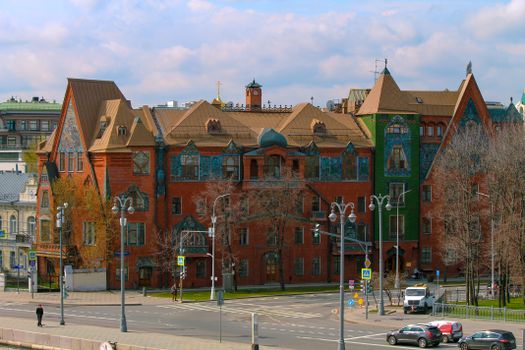
2. Riga, Latvia: The Flamboyant, Screaming Facades of Alberta Iela
When people think of Art Nouveau (or Jugendstil), Brussels and Paris usually get the credit. But the highest concentration of Art Nouveau architecture in the world isn't in Belgium or France—it’s in Riga, Latvia. Over one-third of the buildings in Riga's quiet center are built in this style, a legacy of the city's late 19th-century economic boom.
``` Riga's Mascarons: .-''''-. / _ _ \ Haunting, hyper-expressive | (o)(o) | stone faces staring down | /\ | from the blue-brick facades \ '==' / of Alberta Street. '-....-' ```
Walk down Alberta Iela (Albert Street), and you will feel as though you are walking through an open-air theater. The buildings here, many designed by the eccentric genius Mikhail Eisenstein (father of the pioneering Soviet film director Sergei Eisenstein), are aggressively theatrical.
Unlike the organic, whip-lash curves of French Art Nouveau, Riga's "Eclectic" style features towering blue-brick facades adorned with screaming stone faces (mascarons), roaring lions, sphinxes guarding doorways, and towering female figures representing beauty, intellect, and the forces of nature.
The Architectural Blueprint:
- Key Style: Eclectic and Nationalist Romantic Jugendstil
- What to Look For: Giant, expressive stone faces, dramatic vertical window columns, and intricate wrought-iron balconies shaped like peacock feathers.
> Pro-Tip: Skip the crowded afternoon tour groups. Walk Alberta Iela at 7:00 AM. The early morning Baltic sun hits the blue-glazed bricks of number 10a perfectly, making the white stone sculptures pop with dramatic, high-contrast shadows.
---
3. Prague, Czechia: Cubism Brought to Three-Dimensional Life
Prague is famous for its Gothic spires and Baroque domes, but its most revolutionary architectural contribution is something you cannot find anywhere else on Earth: Cubist Architecture.
In the early 1910s, a group of avant-garde Czech architects, including Josef Gočár and Pavel Janák, asked a wild question: If Picasso and Braque can paint in cubist planes, why can't we build in them?
``` The Cubist Diamond: /\ / \ Prague's unique contribution: /\ /\ turning flat, geometric paint / \/ \ strokes into three-dimensional \ /\ / concrete facades. \/ \/ \/ ```
The ultimate manifestation of this experiment is the House of the Black Madonna (Ovocný trh 19) in Prague’s Old Town. Designed by Gočár when he was just 31, the building features a striking, angular facade where windows and columns are fractured into sharp, crystalline planes. The design plays with light and shadow in a way that makes the building feel dynamic, almost as if it is shifting as you walk past it.
Inside, the theme continues down to the smallest detail. The building houses the Grand Cafe Orient, the world's only Cubist cafe. Everything here—from the brass chandeliers and coat hooks to the custom-designed porcelain coffee cups—is geometric and angular.
The Architectural Blueprint:
- Key Style: Czech Cubism
- What to Look For: Crystalline, diamond-cut facades, triangular bay windows, and angular, multi-faceted portals.
> Pro-Tip: While at the Grand Cafe Orient, order their signature "Cubist windbeutel" (a cream puff baked into a perfect, angular square) and pair it with a strong espresso. It’s a sensory tribute to Czech design history.
---
4. Gdańsk, Poland: Dutch Mannerism Reimagined on the Baltic
If you closed your eyes and stepped onto Gdańsk's Długa Street (Long Market), you might easily believe you had been transported to Amsterdam. The street is lined with tall, narrow-fronted merchant houses boasting steep-pitched step gables, elaborate scrollwork, and gilded details.
``` Baltic Step Gables: _/\_ | | Gdańsk's Dutch Mannerism: _| |_ A vibrant, colorful response | | to Amsterdam's classic brick, _| |_ built by wealthy Baltic merchants. |____________| ```
But this isn't Holland. This is Polish Dutch Mannerism. In the 16th and 17th centuries, Gdańsk was a wealthy, semi-autonomous city-state of the Hanseatic League. To show off their immense wealth, the local merchant class hired Flemish and Dutch architects to design their homes.
However, the locals didn't just copy the Dutch; they dialed the luxury up to eleven. The facades in Gdańsk are painted in a vibrant, saturated palette of deep crimson, sage green, and pastel blue, heavily adorned with gold leaf, allegorical stone reliefs, and intricate sundials.
The crown jewel of this style is the Great Armoury (Wielka Zbrojownia), designed by Anthonis van Obberghen. It is a masterpiece of military architecture disguised as a flamboyant, gilded palace, complete with stone gargoyles, statues of Roman soldiers, and two massive, octagonal towers topped with copper spires.
The Architectural Blueprint:
- Key Style: Northern Renaissance / Dutch Mannerism
- What to Look For: Sgraffito wall decorations, step-gabled roofs, ornamental stone portals, and lavish use of gold leaf.
> Pro-Tip: To escape the June crowds, head to Mariacka Street (Amber Street) just after a late-afternoon summer rain. The wet cobblestones reflect the warm light of the streetlamps, and the gargoyles (locally called rzygacze) will actively spit rainwater from the gutters.
---
5. Bucharest, Romania: The Byzantine-Ottoman Fusion of the Brâncovenesc Style
Often called the "Paris of the East" due to its early 20th-century French-influenced neoclassical villas, Bucharest actually harbors a far more fascinating, indigenous architectural style: Brâncovenesc (also known as the Romanian Renaissance).
Developed in the late 17th century under the rule of Prince Constantin Brâncoveanu, this style is a dazzling, highly eclectic fusion of Byzantine, Ottoman, Venetian Gothic, and late Renaissance elements. It represents a physical bridge between the Christian West and the Islamic East.
``` Brâncovenesc Columns: _/\_ |====| Intricately carved stone columns | () | featuring grapevine reliefs and | || | Venetian-style twisted details. /======\ ```
The absolute finest example of this style hidden in the urban jungle of Bucharest is the Stavropoleos Monastery Church. Built in 1724, this tiny, intimate church features an open portico supported by stone columns carved with intricate grapevine reliefs. The facade is adorned with stone medallions depicting saints and floral patterns, while the interior is covered in rich, dark frescoes and hand-carved gilded wood.
The Architectural Blueprint:
- Key Style: Brâncovenesc / Romanian Renaissance
- What to Look For: Loggias (open galleries), twisted stone columns, lobed arches, and rich stone carvings depicting local flora and fauna.
> Pro-Tip: Visit Stavropoleos at dusk. The courtyard is incredibly peaceful, and if you time it right, you can hear the nuns singing Byzantine chants, their voices echoing off the old stone walls.
---
6. Ljubljana, Slovenia: The Playful, Human-Scale Modernism of Jože Plečnik
While Western modernism in the mid-20th century was leaning heavily into cold, sterile concrete and functionalism (think Le Corbusier), one man in Ljubljana was busy creating a warm, playful, and deeply classical vision of modern urban space. That man was Jože Plečnik.
Plečnik single-handedly transformed Ljubljana from a provincial Austro-Hungarian provincial town into a national capital. His approach was highly personal, combining classical columns, obelisks, and balustrades with local materials and a deep respect for human scale.
``` The Triple Bridge: ___________ Plečnik's genius layout: / / \ \ Three separate bridges fanning / / \ \ out across the river, creating / /_______\ \ a grand, pedestrian-only plaza. ```
His masterpiece is the Triple Bridge (Tromostovje). Rather than building a single, massive concrete span over the Ljubljanica River, Plečnik took an existing 19th-century stone bridge and added two diagonal pedestrian bridges alongside it. He decorated all three with elegant white stone balustrades and lamps, creating a grand, theatrical entrance into the Old Town that feels like a Venetian palazzo stretched across a river.
Another must-see is the National and University Library, featuring a facade of rough, red brick interspersed with irregular grey stone blocks—a design meant to mimic the ruins of ancient Rome.
The Architectural Blueprint:
- Key Style: Plečnik Modernism / Classical Art Deco
- What to Look For: Playful use of obelisks, white stone balustrades, classical columns used in unexpected places, and contrasting brick-and-stone textures.
> Pro-Tip: Rent a wooden stand-up paddleboard (SUP) or a kayak and paddle along the Ljubljanica River under the Triple Bridge. Viewing Plečnik's columns and balustrades from water level offers an entirely different appreciation of his architectural genius.
---
Budget & Logistics: Planning Your June 2026 Architectural Pilgrimage
Eastern Europe remains one of the most cost-effective travel regions in the world, offering luxury experiences for a fraction of Western European prices. Here is how the destinations stack up for a trip in June 2026:
| Destination | Est. Daily Cost ($ USD) | Best Time to Visit (June) | How to Get There | Must-Try Local Flavor | | :--- | :--- | :--- | :--- | :--- | | Budapest, Hungary | $80 - $120 | Early June (avoid late June heat waves) | Fly to BUD; direct trains from Vienna/Munich | Kürtőskalács (cinnamon chimney cake) | | Riga, Latvia | $65 - $95 | Mid-June (enjoy the "White Nights" light) | Fly to RIX; Baltic air hub | Black Balsam herbal liqueur in coffee | | Prague, Czechia | $90 - $140 | Early June (weekdays to avoid crowds) | Fly to PRG; high-speed trains from Berlin | Cubist cream puff at Grand Cafe Orient | | Gdańsk, Poland | $70 - $100 | Late June (perfect Baltic sea breezes) | Fly to GDN; direct trains from Warsaw | Pierogi with Baltic wild mushrooms | | Bucharest, Romania | $60 - $85 | Early June (rose gardens are in full bloom) | Fly to OTP | Mici (grilled minced meat rolls) | | Ljubljana, Slovenia| $85 - $120 | Anytime in June (perfect alpine weather) | Fly to LJU; trains from Venice or Zagreb | Kremna rezina (Bled cream cake) |
---
The Verdict: Why You Must Go East in June 2026
Western Europe will always have its charms, but it is currently resting on its laurels, choked by its own popularity. Eastern Europe, by contrast, is a region of architectural rebellion, where historic styles were adapted, twisted, and supercharged with local identity to create something wholly unique.
In June 2026, when the crowds are fighting for a glimpse of the Eiffel Tower or paying €30 to enter a cathedral in Florence, you could be standing alone on Alberta Iela in Riga, watching the morning sun illuminate a stone sphinx. You could be sipping espresso in a cubist chair in Prague, or tracing your fingers along the Byzantine-style stone carvings of Bucharest.
The architecture of the East doesn't just rival the West; it offers a fresher, bolder, and infinitely more rewarding story. It's time to go write yours.
---