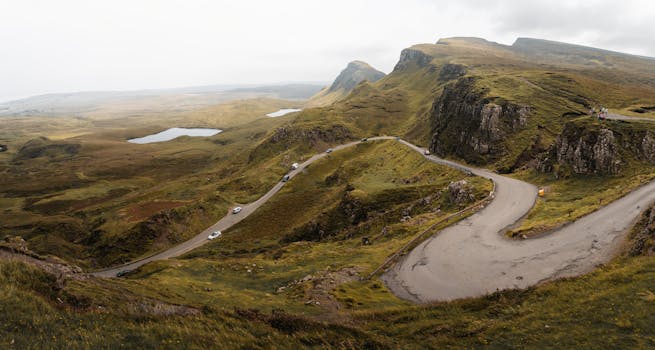
Driving directly from London to Edinburgh covers roughly 650 to 700 km (about 400 to 440 miles) and takes approximately 7 to 9 hours of continuous driving depending on traffic. While it is possible to complete the trip in a single long day, we recommend spending between 3 and 5 days on the road. Spreading the journey across several days allows you to explore historic cathedral towns, walk along dramatic coastlines, and avoid driver fatigue on Britain's busy motorway network.
Main route options: fastest vs scenic
There are two primary driving corridors between the English capital and the Scottish capital: the eastern corridor via the A1(M) and the western corridor via the M1 and M6. Both offer distinct driving environments, landscapes, and potential stopovers.
The East Coast route: A1 and A1(M)
- Distance: roughly 650 km (400 miles)
- Driving time: about 7 to 9 hours without breaks
- Main highlights: Cambridge, York, Durham, and the Northumberland coastline
This is the most direct route between the two cities. Departing London, you follow the A1(M) north past Peterborough, Doncaster, and Leeds before crossing into Yorkshire and the North East. North of Newcastle upon Tyne, the road becomes the primary A1 route, alternating between dual-carriageway and single-lane sections as it runs parallel to the North Sea.
The East Coast route is our preferred choice for first-time road trippers. It passes close to several of England's most significant historic cities and offers striking sea views along the rugged Northumberland coast and the Scottish Borders.
The West Coast route: M1, M6 and A74(M)
- Distance: roughly 660 km (410 miles)
- Driving time: about 7 to 9 hours without breaks
- Main highlights: Peak District access, the Lake District, Carlisle, and Gretna Green
The western alternative uses the M1 out of London, transitions to the M6 past Birmingham and Manchester, and continues north past Lancaster and Cumbria into Scotland via the A74(M) and A702. Almost this entire route consists of multi-lane motorways, making for consistent cruising speeds outside peak commuting hours.
While motorway driving is less scenic from the carriageway itself, this route provides easy detours into the Peak District and the Lake District National Park. If you want to spend a day hiking fells or boating on lakes before continuing to Scotland, the M6 corridor is the better option.
Suggested 4-day itinerary
A 4-day itinerary offers a balanced pace, keeping daily driving time to between 2 and 3 hours and leaving plenty of daylight for sightseeing and walking.
Day 1: London to York
Leave London after the morning rush hour and take the A1(M) north. Plan a lunch stop in the university city of Cambridge or near the market town of Stamford in Lincolnshire, known for its well-preserved Georgian stone buildings. Continue north into North Yorkshire and conclude the day in York. Spend the late afternoon walking the medieval city walls and exploring the narrow streets around the Shambles.
Day 2: York to Durham
Spend your morning visiting York Minster, one of the largest Gothic cathedrals in Northern Europe, before heading north on the A1(M) toward County Durham. In the afternoon, arrive in Durham. The city center is dominated by its Norman cathedral and adjacent castle, perched high on a rocky peninsula above the River Wear. Durham is compact and pedestrian-friendly, making it an easy place to explore on foot.
Day 3: Durham to the Northumberland Coast
Drive north past Newcastle and join the coastal stretch of the A1. Detour slightly east toward the seaside villages of Northumberland. Stop at Alnwick to see the historic castle grounds, then head north to Bamburgh. Bamburgh Castle stands directly on the dunes overlooking broad sandy beaches and the Farne Islands. Stay overnight in a coastal village such as Seahouses or the market town of Alnwick.
Day 4: Northumberland to Edinburgh
From the Northumberland coast, continue north along the A1 to the border town of Berwick-upon-Tweed, famous for its Elizabethan defensive ramparts. Cross into Scotland and follow the A1 past Dunbar into East Lothian, or cut inland through the rolling hills of the Scottish Borders via the A68. Arrive in Edinburgh in the afternoon, drop off your hire car, and settle into the city.
Best places to stop along the way
If you prefer to design your own schedule, consider adding these notable locations to your road trip plan:
- Cambridge: Renowned for its historic university colleges and punting along the River Cam, located just off the M11 north of London.
- Stamford: A picturesque stone-built town in Lincolnshire that makes a convenient midway stop for coffee or lunch on the A1.
- York: Famous for Roman roots, Viking history, intact city walls, and the towering York Minster cathedral.
- Durham: Home to an exceptional Romanesque cathedral and a lively university atmosphere.
- The Angel of the North: A massive steel sculpture by Antony Gormley located right beside the A1 near Gateshead.
- Bamburgh Castle: An imposing fortress set high on a basalt crag overlooking the North Sea coast.
- Lindisfarne (Holy Island): Accessible via a paved tidal causeway just off the A1 in Northumberland. Always verify safe tide crossing times before driving across.
- The Scottish Borders: Towns such as Melrose and Jedburgh feature ruined medieval abbeys set against tranquil green hills.
Where to stay overnight
Choosing the right overnight bases helps avoid congested city centres during morning departures while keeping you close to evening dining options.
- York: An ideal first-night stop on the east route. It offers a large variety of restaurants and pubs within walking distance of central lodgings.
- Durham: A quieter alternative to Newcastle for your second night, with plenty of character and easy access back onto the A1(M).
- Alnwick or Bamburgh: Excellent options for night three if you appreciate coastal scenery and small-town tranquility.
- Keswick or Penrith: If choosing the western route, these Cumbrian towns offer direct access to the Lake District's walking trails.
- Carlisle: A practical, affordable stop on the western route near the Scottish border with historic landmarks like Carlisle Castle.
Best time of year for the road trip
The drive between London and Edinburgh is open year-round, but conditions and seasonal daylight vary significantly.
- Late Spring (May to June): This is one of the best windows for this trip. Days are long, gardens and countryside are vibrant, and summer crowds have not yet peaked.
- Summer (July to August): Warmest weather and the longest daylight hours (often past 9:30 pm in Scotland). However, traffic on the motorways is heavier, and tourist attractions can be busy.
- Autumn (September to October): Early autumn brings pleasant driving temperatures and colourful foliage, especially through Yorkshire and the Scottish Borders. Rainfall increases toward late October.
- Winter (November to March): Days are noticeably short, with sunset arriving as early as 3:30 pm in northern England and Scotland. While motorways are routinely gritted, rural roads through the Pennines and Borders can experience ice and snow.
Tolls, parking and road conditions
Driving in the UK is generally straightforward, but several logistical factors require advance preparation.
- Low emission and congestion zones: Driving in central London incurs the Congestion Charge and the Ultra Low Emission Zone (ULEZ) fee for non-compliant vehicles. Some northern cities like Newcastle also operate clean air zones for commercial vehicles. Check official local council websites for exact vehicle compliance requirements.
- Toll roads: The direct A1/A1(M) route has no road tolls. On the western route, the M6 Toll bypasses Birmingham congestion for a fee, though using the standard M6 is free.
- City parking: Historic towns like York, Durham, and Cambridge have restrictive vehicle access in their historic cores and expensive central parking. We strongly recommend using signposted Park & Ride bus facilities situated on the edge of these cities.
- Road widths: While motorways are wide and well-surfaced, country roads leading to coastal castles and rural villages are often narrow and bordered by stone walls or hedges. Drive cautiously and use designated passing places when required.
Practical driving tips
Proper preparation ensures a smooth journey across the length of Great Britain.
Car hire advice
If you are starting in central London, we recommend taking a train to an outer hub (such as Heathrow Airport or Stansted) or picking up your hire vehicle on the northern outskirts of the city. This avoids navigating central London's heavy urban traffic. If you plan to drop the car off in Edinburgh, check for one-way rental fees with your rental provider.
Fuel and EV charging
Motorway service stations (often signed as "Services") are spaced every 30 to 50 km along the M1, M6, and A1(M). They offer fuel, food outlets, and restrooms 24 hours a day, though fuel prices at motorway services are noticeably higher than at local supermarket stations in nearby towns. Rapid EV charging infrastructure is widespread along the primary motorway corridors, but availability can be scarcer in rural Northumberland and the Scottish Borders.
Driving with children
Long motorway drives can test young passengers. Break up the journey with active stops: walking the fortress walls in York, running along the sandy expanses beneath Bamburgh Castle, or visiting one of the country parks situated along the A1 corridor. Keep loose change or a debit card handy for parking machines, and carry waterproof jackets regardless of the season.
Frequently asked questions
Can you drive from London to Edinburgh in one day?
Yes, the drive takes about 7 to 9 hours without traffic delays and is feasible in one day using the A1(M) or M6. However, it leaves little time to see anything along the way, and motorway delays can extend the journey. We recommend taking at least 2 or 3 days.
Which route is better: the A1 or the M6?
The A1 is generally better for sightseeing because it passes close to historic cities like York and Durham and offers coastal scenery in Northumberland. The M6 is almost entirely motorway, making it slightly more direct if your primary goal is quickly reaching the Lake District or western Scotland.
Are there toll roads between London and Edinburgh?
The standard route along the A1 and A1(M) does not contain any toll roads or toll bridges. If you choose the western route via the M6, you can opt to use the M6 Toll around Birmingham to avoid traffic, though the standard motorway route is toll-free.