Alright, fellow adventurers and pixel-peeping wanderlusters, let’s get real for a minute. How many times have you been scrolling through your feed, a cup of lukewarm coffee in hand, only to stop mid-scroll, squint at your screen, and mutter, “No way. That has to be Photoshopped.”? I know I have. My thumb hovers over the "like" button, then the "share," but a tiny voice in my head whispers, "Is it even real?"
That voice used to be loud. It used to make me doubt the incredible. But then, I started traveling. And let me tell you, the world is a far wilder, more imaginative place than any filter or editing software could ever conjure. I’ve stood on ground that felt like another planet, swum in water that defied logic, and witnessed colors that painted the sky like a fever dream. These aren't just pretty places; they're optical illusions, geological masterpieces, and biological wonders that will make you question everything you thought you knew about Earth.
So, buckle up, buttercups! I’m taking you on a journey to some of the most mind-bending, "fake-but-real" photo spots trending right now – places that will not only blow up your Instagram but also etch themselves into your soul as truly unforgettable experiences. And yes, I'll even share my personal tips and tricks to get that shot.
1. Salar de Uyuni, Bolivia: Walking on Clouds, Literally
My first encounter with the Salar de Uyuni was a photo – a group of people standing on what looked like an infinite mirror, the sky above indistinguishable from the ground below. "Impossible," I thought. But then I went. And let me tell you, nothing, absolutely nothing, prepares you for the sheer, breathtaking scale of the world's largest salt flat.
The Experience: Imagine 10,582 square kilometers of blinding white salt, stretching to the horizon. During the rainy season (roughly December to April), a thin layer of water transforms the Salar into the most incredible natural mirror you'll ever witness. It’s like walking on a cloud, or floating between two identical skies. The silence out there, broken only by the crunch of salt beneath your boots, is profound. I remember sitting on the edge of our 4x4, watching the sunset paint the "sky below" in hues of orange and purple, feeling utterly insignificant yet completely connected to something ancient and vast. It’s a place where perspective photography thrives – think giant humans holding tiny cars, or friends balancing on the edge of a spoon. It's pure magic.
Getting There & Practicalities:
- Location: Southwest Bolivia, near the town of Uyuni.
- Best Time to Visit: For the mirror effect, go during the rainy season (December to April). For dry, cracked salt patterns, visit during the dry season (May to November).
- Tours: You must go with a guided tour, usually 3-day/2-night trips from Uyuni, San Pedro de Atacama (Chile), or Tupiza (Bolivia). Prices vary but expect around $150-$250 USD per person, including food and basic accommodation. I went with "Red Planet Expeditions" and had a fantastic guide who knew all the best photo spots.
- What to Pack: Sunscreen (the glare is intense!), sunglasses, hat, layers (temperatures fluctuate wildly), rubber boots (essential for the mirror effect), a good camera, and a sense of humor for the basic accommodations.
- Altitude Sickness: Uyuni is high (around 3,656 meters or 12,000 feet). Acclimatize in La Paz or Sucre beforehand. Drink coca tea!
Photo Tips:
- Perspective is Key: Bring props like toy dinosaurs, empty water bottles, or even just your hands to create hilarious perspective shots against the vast backdrop.
- Reflections: During the rainy season, get low to the water for stunning reflections. A wide-angle lens is your best friend here.
- Golden Hour: Sunrises and sunsets are otherworldly. The colors reflected in the water are simply divine.
- Tripod: Essential for long exposures, especially at night when the stars above and below create a truly cosmic scene.
2. Zhangye Danxia National Geopark, China: Mountains That Belong in a Painting
When I first saw photos of Zhangye Danxia, I thought it was a landscape artist's fever dream. Mountains striped with vibrant reds, yellows, greens, and blues, looking like giant layers of cake or an alien rainbow. It’s one of those places that simply doesn't compute until you see it with your own eyes.
The Experience: Located in Gansu province, these "rainbow mountains" are a geological masterpiece, formed over millions of years by sandstone and mineral deposits. Walking along the designated boardwalks, ascending to various viewing platforms, you can't help but feel like you've stepped into a hyper-realistic painting. The colors shift with the light, deepening and softening as the sun moves across the sky. My guide told me stories of local legends, how ancient gods painted the mountains, and honestly, it felt plausible. The sheer scale and intricate patterns are mesmerizing; every turn offered a new, breathtaking vista.
Getting There & Practicalities:
- Location: Near Zhangye City, Gansu Province, China.
- Best Time to Visit: Late afternoon (around 4-6 PM) or early morning for the best lighting. Summer and autumn (June-October) offer pleasant weather.
- Admission: Entry fee is around 75 CNY (approx. $11 USD) for the park and shuttle bus.
- Getting Around: Once inside, you take shuttle buses between four main viewing platforms. The buses are efficient and frequent.
- Accommodation: Stay in Zhangye City; there are plenty of hotels.
- Language: Mandarin is dominant. A translation app or a local guide is helpful.
Photo Tips:
- Golden Hour is a Must: The colors are most vibrant and saturated during sunrise and sunset. Plan your visit accordingly.
- Wide-Angle Lens: To capture the vastness and layers of the mountains.
- Zoom Lens: For isolating specific colorful patterns and textures.
- Composition: Use the boardwalks or other elements to lead the eye into the frame. Don't be afraid to experiment with different angles from the platforms.
3. Antelope Canyon, Arizona, USA: Sculpted by Light and Time
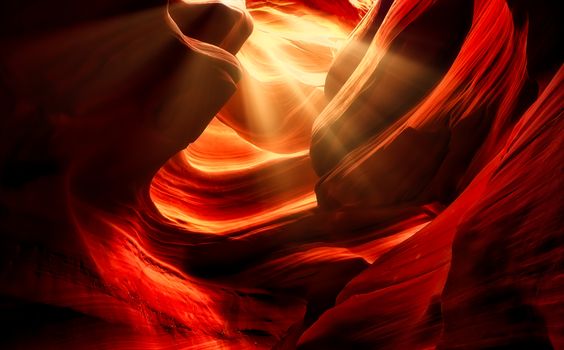
Antelope Canyon had been on my bucket list for years, ever since I saw those iconic photos of light beams piercing through swirling sandstone. It looked like a CGI creation, too perfect to be real. But stepping inside, I understood why it's such a trending photo spot – it's an experience that transcends mere visuals.
The Experience: This slot canyon, carved by millennia of wind and water, is a masterpiece of natural architecture. The Navajo guides lead you through narrow passages where the sandstone walls curve and ripple like liquid stone. The light filtering down from above creates a dynamic play of shadows and vibrant oranges, reds, and purples. It’s eerie, beautiful, and utterly humbling. My guide, a member of the Navajo Nation, shared stories of the canyon's spiritual significance, making the experience even more profound. When those famous light beams suddenly appeared, cutting through the dusty air like spotlights from another dimension, my jaw genuinely dropped. It’s an ethereal, almost spiritual experience.
Getting There & Practicalities:
- Location: Near Page, Arizona, on Navajo Nation land.
- Upper vs. Lower Antelope Canyon: Upper Canyon is famous for its light beams (mid-day, May-September) and wider floor. Lower Canyon is narrower, longer, and requires climbing stairs and ladders, offering different photographic opportunities. Both are stunning.
- Tours are Mandatory: You must book a guided tour with a licensed Navajo tour operator. Book months in advance, especially for mid-day tours during peak light beam season. Prices range from $60-$100+ USD per person. I did an Upper Canyon tour with "Antelope Canyon Tours by Chief Tsosie" and they were fantastic, even helping with camera settings.
- What to Bring: Water, comfortable shoes, and your camera. Leave large bags in your car.
- Dust: It can be dusty inside, so protect your camera gear.
Photo Tips:
- Timing is Everything: For the iconic light beams in Upper Antelope Canyon, book a mid-day tour (10 AM - 2 PM), typically from May to September.
- Camera Settings: Your guide will often provide tips. Use a wide-angle lens. Increase ISO, use a relatively fast shutter speed, and often a smaller aperture (f/8-f/11) to get good depth of field. White balance can be tricky; experiment with "shade" or "cloudy" settings for warmer tones.
- No Tripods: Tripods are generally not allowed on standard tours due to space and time constraints.
- Focus on the Curves: Even without light beams, the sculpted walls offer endless opportunities for abstract and beautiful compositions.
4. Lake Hillier, Western Australia: The Pink Lake Mystery
A bubblegum pink lake, nestled on an island, surrounded by a ribbon of white salt, emerald green forest, and the deep blue of the Southern Ocean. It sounds like something out of a Dr. Seuss book, right? But Lake Hillier in Western Australia is 100% real, and its vibrant hue is one of nature's most baffling and beautiful secrets.
The Experience: I first saw Lake Hillier from a scenic flight, and the sight was utterly surreal. From above, it looks like a giant blob of strawberry milkshake dropped into a pristine wilderness. The contrast between the shocking pink, the dense green eucalyptus forest, and the brilliant blue ocean is almost too much for the eyes to process. It’s not just a trick of the light; the water is truly, unequivocally pink. Scientists believe the color comes from a microalgae called Dunaliella salina and halobacteria in the salt crusts. It's a closed system, completely natural, and utterly mesmerizing. It’s a place that makes you feel like you’ve stumbled upon a secret corner of the planet.
Getting There & Practicalities:
- Location: Middle Island, Recherche Archipelago, off the coast of Esperance, Western Australia.
- How to See It: The most common and best way to view Lake Hillier is via a scenic flight from Esperance. Prices for flights can range from $200-$400 AUD per person, depending on the duration and operator (e.g., Goldfields Air Services).
- Limited Access: Middle Island is a nature reserve, and landing access to the lake is extremely restricted to protect the delicate ecosystem. You can't swim in it.
- Best Time: The pink color is consistent year-round, but a sunny day will make it pop even more.
Photo Tips:
- Aerial Photography: This is where your phone or camera's wide-angle lens shines. Capture the incredible contrast of pink, green, and blue.
- Drone Photography (with caution!): If you're a licensed drone operator and are aware of all local regulations (always check for restricted airspace, especially near wildlife or airports), a drone can capture incredible perspectives. Be respectful and responsible.
- Capture the Context: Try to include the surrounding forest and ocean in your shots to emphasize the surreal contrast.
5. Waitomo Glowworm Caves, New Zealand: A Starry Sky Underground
Imagine floating silently in a small boat, deep within a cavern, and looking up to see thousands of tiny, twinkling lights illuminating the darkness above you. It's not a planetarium; it's the Waitomo Glowworm Caves in New Zealand, and it feels like gazing at a galaxy of living stars. This was one of those moments where I actually teared up a little – it was just so incredibly beautiful and otherworldly.
The Experience: These ancient limestone caves are home to Arachnocampa luminosa, a species of glowworm unique to New Zealand. They hang from the cave ceilings, emitting a bioluminescent light to attract prey. The main attraction is the silent boat ride on the underground river, where you glide beneath a ceiling blanketed with these tiny, blue-green lights. It’s like sailing under a cosmic sky, completely silent except for the gentle ripple of water. The guides are incredibly knowledgeable, explaining the lifecycle of the glowworms and the geology of the caves. It's a truly magical and humbling experience that feels straight out of a fantasy movie.
Getting There & Practicalities:
- Location: Waitomo, North Island, New Zealand, about 2.5 hours south of Auckland.
- Tours: The "Waitomo Glowworm Caves" are the most famous. Tours run frequently throughout the day, costing around $55-$65 NZD per adult. Book online in advance, especially during peak season.
- Photography Restrictions: Due to the sensitivity of the glowworms and to maintain the magic of the experience, flash photography is strictly prohibited, and often any photography during the boat ride is not allowed. This is a place to experience with your eyes and heart, not just through a lens. My advice: embrace it!
- Other Caves: There are other caves in the area like Ruakuri Cave (more adventurous, allows limited photography) and Aranui Cave (dry cave, beautiful formations).
Photo Tips:
- Embrace the Experience: Seriously, put your camera away for the boat ride. The memory will be far more vivid than any blurry, high-ISO shot you might try to sneak.
- Postcard Power: They sell incredible postcards and professional photos at the visitor center. Support local artists and get a high-quality keepsake.
- Outside Shots: Focus on capturing the lush, green entrance to the caves or the surrounding landscape.
6. Grand Prismatic Spring, Yellowstone National Park, USA: Earth's Fiery Eye
Yellowstone National Park is a wonderland of geothermal activity, but nothing quite prepares you for the sheer, vibrant spectacle of the Grand Prismatic Spring. It's a massive, steaming pool of water painted in every color of the rainbow, looking like Earth's fiery, psychedelic eye.
The Experience: This is the largest hot spring in the United States and the third-largest in the world. The colors – deep blues and greens in the center, transitioning to vibrant yellows, oranges, and fiery reds at the edges – are caused by different species of heat-loving bacteria and algae that thrive in the varying temperatures of the outflow channels. When I first approached the boardwalk, the steam rising off the spring made it feel incredibly mysterious. Then, as the wind shifted, revealing the full spectrum of colors, it was like looking at a giant, living tie-dye masterpiece. The scale is immense, and the colors are so saturated they almost hurt your eyes. It’s a powerful reminder of the raw, untamed forces shaping our planet.
Getting There & Practicalities:
- Location: Midway Geyser Basin, Yellowstone National Park, Wyoming, USA.
- Best Time to Visit: A sunny day helps bring out the colors. Early morning or late afternoon can offer less crowded boardwalks.
- Viewing: There's a boardwalk that takes you right alongside the spring. For the iconic aerial-like view, hike the Grand Prismatic Spring Overlook Trail (a 0.8-mile round trip from the Fairy Falls Trailhead parking lot). This elevated perspective is crucial for seeing the full color spectrum.
- Park Entry: Yellowstone National Park has an entrance fee (around $35 USD for a 7-day private vehicle pass).
- Safety: Stay on marked boardwalks and trails. The water is boiling hot and highly acidic.
Photo Tips:
- Overlook Trail is Essential: To truly capture the grandeur and full color spectrum, hike to the Grand Prismatic Spring Overlook. This is where you get that shot.
- Wide-Angle Lens: To encompass the immense size and vibrant colors.
- Dealing with Steam: Steam can obscure the view. Be patient, wait for gusts of wind to clear the air, and be ready to shoot quickly.
- Colors Pop on Sunny Days: The sunlight makes the colors more vivid.
- Drone Photography: Strictly prohibited in all US National Parks. Respect the rules!
Ready to Un-Fake Your Reality?
There you have it, fellow travelers – a glimpse into a world where reality is far stranger and more beautiful than fiction. These "fake-but-real" photo spots aren't just trending hashtags; they're testaments to the incredible artistry of Mother Nature, places that challenge our perceptions and ignite our wanderlust.
Standing in these locations, you don't just take a photo; you feel the earth's ancient power, the delicate balance of ecosystems, and the sheer, unadulterated beauty that exists beyond our screens. So, next time you see a picture that makes you doubt its authenticity, remember these places. Remember that the world is full of wonders waiting to be discovered, experienced, and yes, shared (responsibly, of course!).
Which of these mind-bending destinations will be your next real-life photo op? Tell us in the comments below! And don't forget to share this post with your travel buddies who also think everything on Instagram is fake. Let's prove them wrong, one unbelievable adventure at a time!