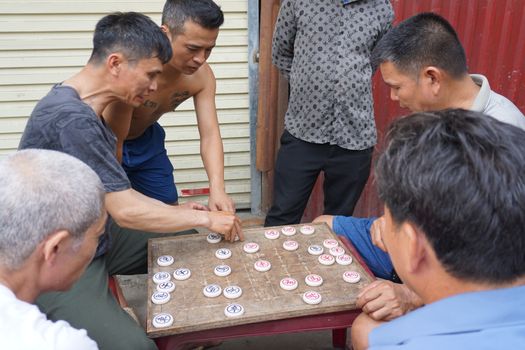
The sun beat down on the dusty square in Chiang Mai, Thailand. I was nursing a lukewarm bottle of Chang beer, ostensibly "people-watching," but mostly just feeling a bit… disconnected. Around me, tourists snapped selfies with temples, and tuk-tuks whizzed by. It was lovely, don't get me wrong, but it felt like I was watching a movie of a place, not truly being in it.
Then, across the square, a small group of men started playing. The ball, a woven rattan sphere, flew through the air with impossible grace. Feet, heads, and chests kept it aloft, never touching the ground. It was like volleyball, but with zero hands. My jaw dropped. This wasn't in any guidebook. This wasn't on any influencer's "Top 10 Things to Do in Thailand" reel. This was real.
Curiosity, and perhaps a touch too much Chang, propelled me forward. I watched, mesmerized, for what felt like an hour. Finally, one of the players, a man with a mischievous grin and sweat beading on his brow, caught my eye. He gestured, "Come, try!" My initial instinct was to politely decline, to retreat to my tourist bubble. But something in his eyes, a genuine invitation, made me step out of my comfort zone.
What followed was a clumsy, hilarious, and utterly unforgettable attempt at playing Sepak Takraw. I probably looked like a baby giraffe trying to walk, but the laughter – shared, genuine laughter – transcended any language barrier. In those moments, kicking that rattan ball with strangers, I wasn't a tourist anymore. I was just a person, connecting with other people, in the most joyful, unscripted way imaginable.
This, my friends, is what travel should be about. It’s about those unscripted moments, those genuine connections that no filter can replicate. It’s about the traditional games locals will teach you, the ones Instagram influencers don’t want you to know about because they can’t easily package them into a perfectly curated story. But trust me, these are the stories you’ll tell for years.
Why Ditch the Filters for Footwork? The True Value of Local Games
In an age of hyper-curated travel content, where every sunrise is perfectly framed and every meal meticulously styled, it’s easy to feel like you’re missing out if your trip doesn’t look like a magazine spread. But true connection, the kind that transforms a trip into an adventure, rarely happens through a lens. It happens when you put down your phone and engage.
Traditional games are a universal language. They transcend linguistic barriers, socio-economic differences, and even age gaps. They are a window into a culture’s values – their emphasis on community, strategy, physical prowess, or even just pure fun. More importantly, they are an instant icebreaker. Imagine walking into a new place and, instead of feeling like an outsider, you’re invited to participate, to learn, to laugh. That’s the magic of it.
Not only are these experiences deeply enriching, but they're also often incredibly budget-friendly (sometimes even free!) and inherently sustainable. You're supporting local culture, interacting directly with communities, and creating memories that don't rely on expensive tours or manufactured attractions. So, let’s explore some of these hidden gems and how you can find your own game-changing travel moments.
---
1. Sepak Takraw: The Aerial Ballet of Southeast Asia
Where to find it: Primarily Thailand, Malaysia, Indonesia, and other parts of Southeast Asia. You'll spot games in local parks, on beaches, or even just on quiet street corners.
What it is: Imagine volleyball, but instead of hands, players use their feet, knees, chest, and head to keep a small, woven rattan ball (a takraw) in the air over a net. It’s incredibly athletic, graceful, and requires immense coordination and agility. Think acrobatic soccer-volleyball.
My Story: After my initial clumsy attempts in Chiang Mai, I became mildly obsessed. I’d actively seek out games. In a small village outside Luang Prabang, Laos, I stumbled upon a group of kids playing with an old, tattered takraw. They initially giggled at my attempts, but then patiently showed me how to use my instep, how to "head" the ball without getting a concussion, and most importantly, how to laugh at myself. We communicated mostly through gestures and smiles, but the connection was profound. They shared their sticky rice snacks, and I shared my bottled water. It was simple, authentic, and pure joy. The sunset cast long shadows as we played, and I remember thinking, "This is it. This is why I travel."
Practical Tips:
- Look for parks and public squares: Especially in the late afternoon or early evening when the heat subsides. Beach areas are also common.
- Observe first: Watch a game or two to get a feel for the rules and flow.
- Approach with a smile: A simple "Sawasdee krap/ka" (hello in Thai) or "Apa khabar?" (how are you in Malay/Indonesian) goes a long way. Point to the ball, make a questioning gesture. Most locals are delighted to share their culture.
- Don't be afraid to be bad: Seriously, you will be terrible at first. Embrace it! Your willingness to try and your good humor will be appreciated far more than your skill.
- Cost: Usually free to join. Offering to buy a round of water or a local snack afterward is a nice gesture.
Instagram-worthy moment (the authentic kind): A dynamic shot of the rattan ball mid-air, framed by the blur of a player’s foot, with genuine smiles and sweat-kissed faces in the background. A slow-motion video of an attempted kick (yours, probably failing spectacularly) always gets a laugh.
---
2. Tejo: The Explosive National Sport of Colombia
Where to find it: Colombia, specifically in dedicated canchas de tejo (tejo courts), often found in unassuming buildings or open-air sheds on the outskirts of towns and cities. Bogota has many.
What it is: This isn't your grandma's bocce ball. Tejo involves throwing a heavy metal disc (tejo) across a long court, aiming to hit a small ring (mecha) filled with gunpowder, embedded in a clay pit. If you hit the mecha, it explodes with a satisfying BANG! It's traditionally played with beer in hand, making it a truly unique social experience.
My Story: My first experience with Tejo was in Bogotá, after a local friend insisted it was "an essential Colombian experience." We arrived at a dimly lit cancha filled with the smell of beer, clay, and gunpowder. The air was thick with laughter and the occasional, startling explosion. My friend explained the rules – basically, hit the mecha for points, but a louder explosion means more points (not really, but it felt like it!). My first few throws were embarrassingly off-target, burying the tejo deep in the clay. Then, with a beginner's luck throw, I heard it: a sharp, exhilarating BANG! A small puff of smoke rose from the pit. The whole court erupted in cheers, strangers high-fiving me. The adrenaline, the communal joy, the cheap local beer – it was a sensory overload in the best possible way. We played for hours, the explosions echoing, the conversation flowing, and by the end, I felt like I truly understood a piece of Colombian soul.
Practical Tips:
- Ask a local: This is the best way to find a good cancha de tejo. Many look unassuming from the outside.
- Go with friends (or make some): It’s a team game, and the more the merrier. If you're solo, politely ask if you can join a group. Offer to buy the first round of beers.
- Safety first: While generally safe, be aware of flying clay and the explosive nature. Listen to the locals’ advice.
- Embrace the atmosphere: It's loud, it's boisterous, it's authentic. Don't expect a quiet, refined experience.
- Cost: Usually just the cost of your drinks. The courts themselves are often free to use.
Instagram-worthy moment (the authentic kind): A slow-motion video of a tejo hitting the mecha and the subsequent explosion! Or a wide shot of the lively cancha, people cheering, beers in hand, with a clay-covered tejo in the foreground.
---
3. Petanque/Bocce: The Relaxed Charm of Mediterranean Europe
Where to find it: France (Petanque), Italy (Bocce), Spain, and other Mediterranean countries. Look for public squares, parks, and dedicated boulodromes (petanque courts) in towns and villages.
What it is: A classic boules game where players take turns throwing hollow metal (Petanque) or solid wooden/plastic (Bocce) balls as close as possible to a small target ball (cochonnet in French, pallino in Italian). It's a game of precision, strategy, and often, gentle banter. It's the epitome of a leisurely afternoon.
My Story: In a sleepy village in Provence, France, I was strolling through the main square, enjoying the scent of lavender and freshly baked bread. Under the shade of plane trees, a group of elderly men were engaged in a spirited game of Petanque, their quiet murmurs punctuated by the clink of metal balls. One of them, a jovial man with a magnificent mustache, noticed me watching. "Venez, mon ami!" he called, gesturing with a pastis in hand. I hesitated, feeling my rudimentary French wouldn't cut it. But the warmth in his eyes was irresistible. He handed me a boule and, with patient hand gestures and a few broken English words, explained the basics. I was terrible, of course, but they cheered my rare good throws and good-naturedly ribbed me for my misses. We shared pastis, discussed the weather, and for a few hours, I was part of their daily ritual. It was a gentle, beautiful immersion, proving that connection doesn't always need grand gestures or exotic locations. Sometimes, it's just a game of boules and a shared drink.
Practical Tips:
- Look for shaded squares: Especially in the afternoon, you’ll often find locals playing.
- Observe, then ask: A polite "Bonjour, puis-je joindre?" (Can I join?) in French, or "Posso unirmi?" in Italian, goes a long way.
- Learn basic etiquette: Don't step on the court while others are throwing. Respect the 'pointing' or 'shooting' strategies.
- Enjoy the pace: These games are about relaxation and conversation as much as competition.
- Cost: Usually free. Offering to buy a round of drinks (pastis in France, aperitivo in Italy) is a kind gesture.
Instagram-worthy moment (the authentic kind): A close-up of weathered hands holding a shiny boule, with a blurred background of a charming European square and locals engrossed in play. A video of the satisfying clink as boules collide.
---
4. Mancala/Oware: The Ancient Strategy Game of Africa
Where to find it: Across Africa, the Middle East, and parts of Asia. It has countless variations and names (e.g., Oware in Ghana, Bao in East Africa, Kalaha in other regions). You’ll find people playing it in markets, village squares, community centers, and even just carved into the ground.
What it is: Often called a "sowing game," Mancala is a family of strategy board games played with small stones (or seeds, beans, shells) and a board of pits or holes. The objective is usually to capture more "seeds" than your opponent by strategically "sowing" them around the board. It requires foresight, planning, and a deep understanding of patterns.
My Story: In a bustling market in Accra, Ghana, the vibrant chaos was overwhelming. Amidst the haggling and the calls of vendors, I noticed a quiet tableau: two elderly men, their faces etched with wisdom, intensely focused on a wooden board with twelve carved pits. They were playing Oware, a local variant of Mancala. The rhythmic click of the seeds being moved from pit to pit was almost meditative. I watched for a long time, trying to decipher the complex movements. Eventually, one of the men looked up, a gentle smile creasing his face. He gestured for me to sit. With very few words, mostly pointing and demonstrating, he taught me the basics. It was challenging, humbling, and utterly captivating. The game forced me to slow down, to think, to connect on a level that transcended speech. It felt like I was tapping into an ancient wisdom, a shared human experience that has existed for millennia. I lost, of course, repeatedly, but each game was a lesson in strategy and patience, and an invaluable cultural exchange.
Practical Tips:
- Look for quiet corners: In busy markets or community areas, you might find people playing.
- Observe and show respect: These are often games of deep concentration. Watch quietly first.
- Ask politely: A simple "Hello" and pointing to the game, with a questioning look, can invite an explanation.
- Be patient: The rules can be complex, and learning will take time. Embrace the learning process.
- Cost: Absolutely free. You might even find hand-carved boards for sale as souvenirs.
Instagram-worthy moment (the authentic kind): A close-up of intricate wooden Mancala boards and hands gracefully moving seeds, with the focused, thoughtful expressions of players in the background. A shot of a game being played on a board carved directly into the earth.
---
How to Get Started & Be a Good Game Buddy: Your Guide to Genuine Connection
So, you’re ready to ditch the curated feeds and dive into the real game? Here’s your playbook for making authentic connections through traditional games:
- Observe, Then Engage: Don’t just barge in. Take a moment to watch the game, understand the flow, and soak in the atmosphere. This shows respect and helps you grasp the basics.
- Smile and Ask: A genuine smile is a universal language. Use simple greetings in the local language (a quick Google search can provide these) and then gesture to the game. "May I join?" or "Can you teach me?" (even with hand gestures) is usually met with enthusiasm.
- Embrace the Language Barrier: Don't let a lack of shared language deter you. Games are visual. Watch, mimic, and let laughter be your primary form of communication. Pointing, nodding, and shaking your head are powerful tools.
- Be Humble, Be Open: You will be bad. You will make mistakes. Embrace it! Laugh at yourself. Your willingness to try, your good humor, and your respect for their culture will open doors far more than any skill level.
- Offer to Contribute (When Appropriate): If the game involves drinks or snacks, offer to buy a round. This is a small gesture that speaks volumes about your appreciation and willingness to participate fully.
- Learn the Local Etiquette: Are there specific ways to congratulate a winner? Is it polite to offer a handshake? Follow the lead of the locals.
- Don't Be Afraid to Ask Questions: If you're unsure about a rule, don't just guess. Politely ask for clarification. Locals will appreciate your interest.
- Be Present: Put your phone away. Resist the urge to constantly document every second (unless you've asked permission and it feels natural). The goal is connection, not content.
- Safety First: Always trust your gut. If a situation feels off, politely excuse yourself. Stick to well-lit, public areas.
- Document Respectfully: If you want to take photos or videos, always ask permission first. A quick "photo?" with a smile and a gesture towards your camera is usually enough. Respect a "no." Focus on capturing the essence of the interaction, not just a posed shot.
Beyond the Game: The Unexpected Perks
Learning a traditional game isn't just about the game itself. It's a gateway. That friendly game of Sepak Takraw might lead to an invitation for dinner with a local family. That intense round of Tejo could end with insider tips on the best local eatery. The quiet wisdom shared during Mancala might offer a perspective you never considered. These are the moments that truly enrich your journey, providing insights and memories that no guide book or travel blog (even ours!) can fully prepare you for.
---
Conclusion: Your Adventure Awaits
The world is full of incredible experiences, many of them hiding in plain sight, just waiting for a curious traveler to discover them. While Instagram feeds might show you picture-perfect sunsets and infinity pools, the true magic of travel lies in stepping off the curated path and into the vibrant, messy, beautiful reality of local life.
Traditional games offer a direct, joyful, and deeply human way to do just that. They break down barriers, forge unexpected friendships, and give you a glimpse into a culture's heart that no amount of sightseeing can replicate. So, on your next adventure, challenge yourself. Put down your phone, look for a game, and let a local teach you something truly unforgettable. You won't just learn a new game; you'll gain a new story, a new friend, and a deeper understanding of the world.
Now it's your turn! Have you stumbled upon an amazing traditional game during your travels? Share your stories and tips in the comments below! Let's inspire each other to seek out these authentic, un-influencer-approved adventures.
---