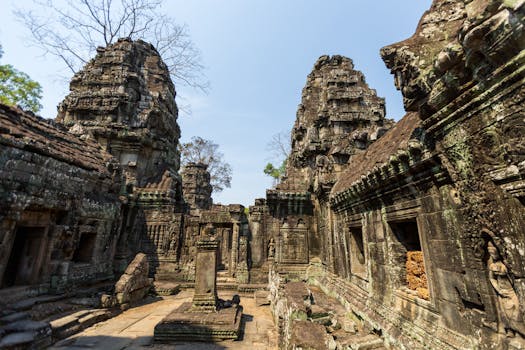
The Angkor Reality Check (And Why You Need to Look Beyond)
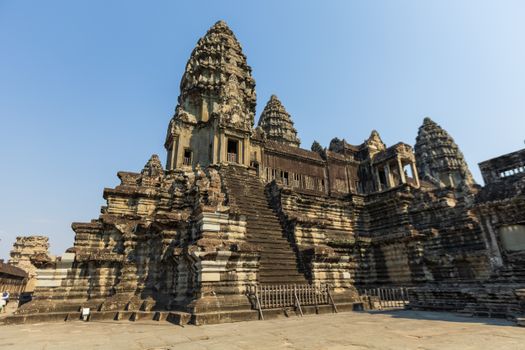
I stepped off the pre-dawn tuk-tuk outside Siem Reap, my lungs stinging with exhaust fumes and red dust. I had spent a decade dreaming of this exact moment: watching the purple dawn break behind the lotus towers of Angkor Wat. Instead, I found myself packed shoulder-to-shoulder against an aluminum railing, listening to a stranger violently clear his sinuses while a forest of iPads blocked the horizon. The reflection pond didn't look like a sacred gateway to the cosmos—it looked like a festival mosh pit.
Angkor Wat is monumental. There is no denying the genius of the Khmer Empire. But when an ancient site becomes a bucket-list trophy, the transcendent reverence that once defined it suffocates under mass commercialization.
The world is dotted with ancient sanctuaries whose scale, architectural audacity, and raw spiritual atmosphere easily equal—and in several jaw-dropping cases, surpass—Angkor. If you are hungry for sites where the hairs on your arms stand up and history feels alive, dangerous, and majestic, skip the tourist conveyer belt.
Here are the sacred masterpieces that truly reset your perspective on human capability.
---
1. Kailasa Temple (Ellora Caves, India): The Impossible Monolith
If aliens landed tomorrow and demanded proof of human genius, I wouldn't take them to the pyramids or Angkor Wat. I would put them on a train to Maharashtra and walk them into Cave 16 at Ellora.
Angkor Wat was built by stacking sandstone blocks with mortar and gravity. Kailasa was carved from the top down out of a single, solid basalt cliff face.
```{r}
Visualizing the scale:
Kailasa: 200,000 tons of volcanic rock chiseled away by hand.
Margin of error: Absolute zero.
```
In the 8th century, Rashtrakuta engineers began at the summit of a sheer mountain and chiseled downward with hammers and chisels, excavating over 200,000 tons of volcanic rock. They didn’t add a single stone; they simply carved away everything that wasn't the temple. What remains is a multi-story, life-sized Dravidian complex featuring towering monolithic obelisks, life-sized sculpted war elephants, and labyrinthine courtyards echoing with the cries of swifts nesting in the rock crevices.
Standing in the courtyard, staring up at the three-story cliff walls that enclose you, the spatial awareness is disorienting. You aren’t inside a building; you are standing inside an excavated mountain.
- Insider Secret: Skip the main central sanctum during midday. Instead, take the unsigned dirt footpath to the cliff rim directly above the temple. Looking straight down into the open-air courtyard gives you a spine-chilling grasp of the architectural mathematics required to hollow out an entire mountain without modern instruments.
- Pro-Tip: Arrive at 06:00 AM on a Tuesday or Wednesday. The morning sun illuminates the western cliff face, casting the deep relief carvings of the Ramayana into razor-sharp contrast before the regional school buses pull up.
---
2. The Sun-Drenched Plains of Bagan (Myanmar): Scale Beyond Comprehension
Angkor Wat is a concentrated cluster; Bagan is an entire geo-spiritual horizon.
Spread over a 26-square-mile desert plain along the Ayeyarwady River sit more than 2,200 surviving Buddhist temples, pagodas, and stupas built between the 9th and 13th centuries. Where Angkor feels enclosed by dense tropical jungle, Bagan feels like an apocalyptic, rust-red chessboard designed by devout giants.
Rent an e-bike, bypass the paved tour routes, and head straight into the dirt tracks. Within ten minutes, the whine of your electric scooter fades into absolute silence. The dry earth smells of wild tamarind, baked clay, and desert dust. You can pull up to an uncataloged 11th-century stupa, slip off your sandals, and step across cool terracotta floor tiles to find a towering gold-leaf Buddha smiling gently through centuries of candle-smoke patina—with not another soul within miles.
Why It Eclipses Angkor:
- The Silhouette Factor: Climactic sunrise over Bagan features a low-hanging morning mist punctuated by thousands of brick spires glowing terracotta-pink in the haze.
- Freedom of Exploration: Angkor requires strict guide routes and barricaded zones. Bagan allows you to lose yourself in an open-air museum where you discover hidden interior staircases and forgotten murals on your own terms.
- Pro-Tip: Forget the crowded hot-air balloons and the over-policed viewing mounds. Head out toward Ta Wet Hpaya or the fields surrounding Sulamani at dawn. Find a quiet ground-level clearing facing east; the view of the spires emerging from the dust as the monastery drums echo in the distance is transcendent.
---
3. Borobudur & Prambanan (Central Java, Indonesia): The Twin Colossi
Clustered outside the cultural hub of Yogyakarta, Central Java holds a one-two architectural punch that beats Angkor's variety: the world’s largest Buddhist monument sitting just miles away from the tallest, most aggressive Hindu temple complex in Southeast Asia.
Borobudur: The Sacred Mandala
Constructed in the 9th century out of two million volcanic andesite river stones, Borobudur is an esoteric cosmic diagram (mandala) built upon a natural hill. Unlike Angkor’s expansive horizontal layout, Borobudur is an active, vertical pilgrimage.
You ascend through nine stacked stone platforms, tracing your fingers along two linear miles of hyper-detailed relief carvings showing ancient ships, royal courts, and Buddhist parables. As you step onto the upper circular terraces, the walls vanish, opening up to a panoramic ring of live volcanoes (including Mount Merapi puffing sulfur smoke into the sky) surrounded by 72 perforated stone stupas, each encasing a seated Buddha.
Prambanan: The Spire of Shiva
While Borobudur is squat and meditative, nearby Prambanan is vertical, razor-sharp, and violent. Its jagged, 154-foot-high central spire dedicated to Shiva the Destroyer shoots toward the sky like an petrified lightning bolt. The bas-reliefs here possess an athletic, muscular dynamism that makes Angkor’s delicate apsaras feel almost static.
- Pro-Tip: Book a guesthouse in the village directly behind Borobudur rather than day-tripping from Yogyakarta. Enter via the Manohara gate at the earliest morning slot to experience the stone stupas before the equatorial heat triggers thick midday humidity and crowds.
---
4. Hampi’s Vijayanagara Empire (Karnataka, India): Surrealism in Granite
If Salvador Dalí had designed an ancient civilization, he would have built Hampi.
Scattered across a surreal, wind-scoured wilderness of precariously balanced granite boulders and emerald-green banana plantations sit the ruins of the Vijayanagara Empire. In the 15th century, Hampi was larger than Rome and one of the wealthiest metropolitan areas on earth. Today, it feels like an alien landscape scattered with royal pavilions, pillared elephant stables, and sacred river ghats.
The crown jewel is the Vittala Temple, famous for its iconic monolithic stone chariot and its halls of "musical pillars"—slender granite columns tuned to specific acoustic frequencies that produce distinct musical notes when tapped by hand.
The Atmosphere
Unlike the polished tourist hub of Siem Reap, Hampi has maintained a raw, agrarian rhythm. You cross the rushing, croc-inhabited Tungabhadra River in circular, woven coracle boats made of wicker and plastic sheeting, climb high granite ridges to find forgotten shrines, and watch wild langur monkeys battle across the stone roofs of the still-active Virupaksha Temple.
- Insider Secret: Hike up Matanga Hill at 05:15 AM via the southern steps. Bring a headlamp. From the summit, you get a 360-degree vantage point across the boulder-strewn landscape as the morning sun turns the granite gold and the sacred chanting from the Virupaksha bazaar drifts up through the valley mist.
- Pro-Tip: Refuel in the village with a piping-hot plate of ghee roast dosa and cardamom chai at the unassuming roadside shacks near the river crossing—far superior to any westernized café in the area.
---
5. Baalbek (Beqaa Valley, Lebanon): The Giants' Megaliths
Angkor Wat's engineering is impressive, but Baalbek’s sheer physical mass is terrifying.
Known in classical antiquity as Heliopolis, this Roman temple complex in Lebanon features some of the largest stone blocks ever moved by human beings. The foundations of the Temple of Jupiter incorporate three legendary megaliths known as the Trilithon, each weighing an estimated 800 tons. For context: a single one of these stones weighs more than an entire Boeing 747 fully fueled and loaded with passengers. They are fitted together with such micro-precision that you cannot slide a razor blade between the seams.
Just beside it stands the Temple of Bacchus, preserved in such pristine, jaw-dropping condition that it makes the Roman Forum look like a field of scattered gravel. Its soaring 66-foot-high fluted limestone columns, intricate stone-carved ceilings displaying Dionysian revelry, and colossal 42-foot-tall portal dwarfs anything Angkor can throw at you in terms of vertical scale.
- Logistics & Safety Note: Baalbek sits in the Beqaa Valley. While international headlines frequently paint the region as unstable, thousands of heritage travelers visit smoothly every year via reliable private drivers hired directly out of Beirut (a 2-hour scenic climb over Mount Lebanon). Always verify the current security posture with local expat networks rather than outdated consulate warnings.
- Pro-Tip: Hire an authorized site guide at the entrance gate purely to gain access to the elevated substructure galleries, where the mind-boggling scale of the megalithic construction can be inspected at eye level.
---
6. Tikal (Peten Basin, Guatemala): Raw, Unforgiving Jungle Dominance
Angkor’s Ta Prohm (the famous "Tomb Raider temple") has trees growing over its stone walls, but the experience is curated: wooden boardwalks keep you safely on track, and rope barriers keep you from getting too adventurous.
If you want the real, uncensored, primeval temple expedition, catch a puddle-jumper flight to northern Guatemala and walk into Tikal.
Rising out of the deep, suffocating canopy of the Maya Biosphere Reserve, Tikal’s limestone temple-pyramids shoot straight toward the sky at shockingly steep, nearly vertical angles. Temple IV rises over 213 feet into the sky. When you scale the wooden service steps to its summit platform, you emerge above the rainforest canopy. As far as the eye can see, there is nothing but an endless sea of green jungle foliage punctuated by the jagged gray stone crowns of Temples I, II, and III piercing the clouds.
The Sensory Shock
Tikal is not quiet. Long before dawn breaks, the deep, guttural, demonic roar of black howler monkeys rattles through the ancient limestone plazas, sounding like a pack of prehistoric beasts hunting between the plazas. Emerald toucans flash through the mahogany trees, and the air hangs thick with the scent of wet mulch, wild cedar, and damp limestone moss. It is ancient, untamed, and entirely unbothered by human presence.
- Insider Secret: Secure a special-access Sunrise Permit (available through the park office). You must enter the park in total darkness at 04:00 AM. Guide your footsteps by red-light headlamp along the jungle trails, listening to the rainforest wake up, and sit atop Temple IV in pitch-black solitude before the first rays of light reveal the jungle sea below.
---
Quick Facts & Tactical Logistics
To help you decide which sacred wonder should replace Angkor on your travel docket, here is a tactical breakdown of costs, accessibility, and ideal travel seasons:
| Temple Complex | Location | Est. Daily Budget ($ USD) | Best Time to Visit | How to Get There | The "X-Factor" Rivaling Angkor | | :--- | :--- | :--- | :--- | :--- | :--- | | Kailasa Temple | Maharashtra, India | $35 - $60 (Budget/Mid) | November to February | Fly to Aurangabad; 45-min taxi to Ellora Caves. | Entire temple complex carved top-down from a single volcanic mountain. | | Bagan | Mandalay Region, Myanmar | $40 - $70 (Budget/Mid) | October to March | Domestic flight to Nyaung-U; private car from Mandalay. | 2,200+ ancient stupas spread over a surreal, rideable desert plain. | | Borobudur & Prambanan | Central Java, Indonesia | $50 - $100 (Mid-range) | May to September (Dry Season) | Fly into Yogyakarta International (YIA); 1-hour private driver. | Cosmic 9-tier stone mandala matched with 150ft soaring Hindu towers. | | Hampi | Karnataka, India | $25 - $50 (Shoestring/Mid) | October to March | Overnight luxury train from Bangalore to Hospet; 20-min auto-rickshaw. | Monolithic musical pillars set against a wild, boulder-strewn desert oasis. | | Baalbek | Beqaa Valley, Lebanon | $80 - $150 (Private transport) | April to June / Sept to October | 2-hour private vehicle hire from downtown Beirut. | 800-ton Roman foundation megaliths and exceptionally preserved colossi. | | Tikal | Petén Basin, Guatemala | $60 - $120 (Mid-range) | December to April (Dry Season) | 45-min domestic flight from Guatemala City to Flores; 1-hour shuttle. | Steep, towering pyramids piercing the canopy of a howling tropical jungle. |
---
The Verdict: Which One Deserves Your Ticket?
Angkor Wat will always hold a place in architectural history. But travel isn’t just about verifying a famous postcard—it is about the raw, visceral shock of stepping into spaces where human ambition touched the divine.
- If you want pure engineering insanity, book the flight to India for Kailasa Temple.
- If you want the romance of uncharted exploration, lose yourself on an e-bike in Bagan.
- If you crave pure wild atmosphere, climb through the morning mist above the trees at Tikal.
Pack your boots, leave the selfie-stick at home, and go witness the sacred world the way it was meant to be experienced: in awe, in silence, and with your boots covered in red dust.